This title is also available from
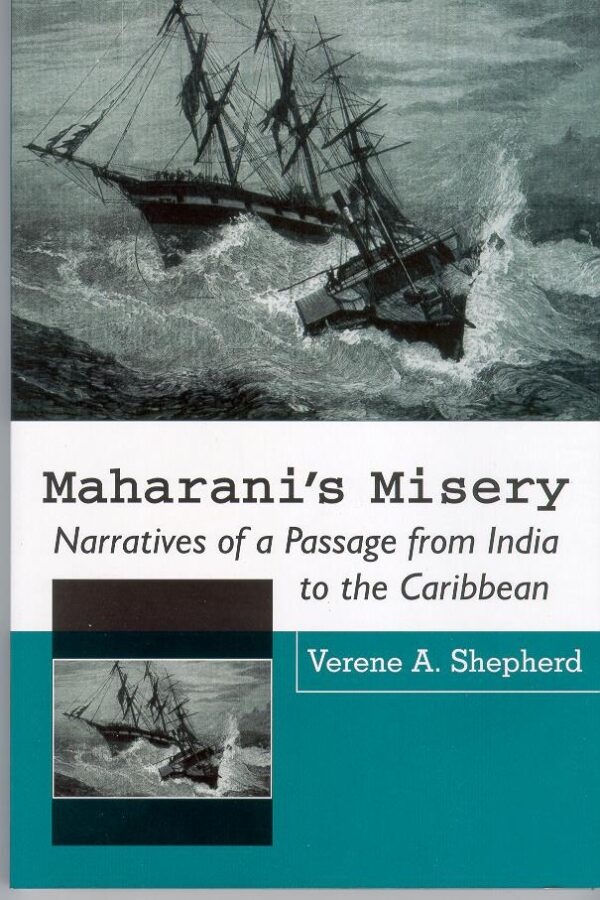
Maharani's Misery
Narratives of a Passage from India to the Caribbean
This book continues the ongoing archaeological project of excavating gender-differentiated data on the nineteenth-century post-slavery relocation of bonded labour to the colonial Caribbean. In a broader context, it contributes to that genre of historical writing that focuses on the exercise of social power and authority, through the medium of socio-sexual manipulation, by empowered males over subaltern women. The book combines documentary evidence with a surrounding narrative interpretation in order to highlight the experiences of the young Indian woman, Maharani, who was raped, and died subsequently, on board the ship Allanshaw that sailed from Calcutta to colonial Guyana in 1885. The events on this passage from India should provide further that nineteenth-century labour "migration" replicated several aspects of the Middle Passage of enslaved Africans, although it was never allowed to reach slavery's brutal limits.
- List of Illustrations
- List of Tables
- Cast of Characters
- Preface
- Introduction
- PART I Indian Women and Labour Migration: Background to Maharani's Passage from India
- Journey Interrupted: Maharani's Death on the Allanshaw
- Investigating the Complaint of "Criminal Assault
- Conclusion
- PART II Appendices: Minutes of Evidence Taken before the Commission of Enquiry in Colonial Guyana
- Appendix 1 Surgeon-Superintendent Dr E.A Hardwicke
- Appendix 2 Captain Frederick C. Wilson
- Appendix 3 William Urquhart (Sailmaker)
- Appendix 4 Mohadaya (Return Emigrant)
- Appendix 5 Moorti (Return Emigrant)
- Appendix 6 Golap (Nurse)
- Appendix 7 James T. Grant (Assistant Compounder)
- Appendix 8 Robert Ipson (Able Seaman)
- Appendix 9 John Smith (Able Seaman)
- Appendix I0 James T. Grant (Recalled)
- Appendix 11 G.W. de la Mare (Chief Officer)
- Appendix 12 Alexander Bain (Able Seaman)
- Appendix 13 William Lee (Able Seaman)
- Appendix 14 Walter R.S. Stokes (Third Officer)
- Appendix 15 August Makohl (Engineer)
- Appendix 16 Joseph Warner (Able Seaman)
- Appendix 17 Captain F.C. Wilson (Recalled)
- Appendix 18 Lutchmun (Return Emigrant)
- Appendix 19 Heerdayaram (Hospital Attendant)
- Appendix 20 William Clintworth (Cabin Boy)
- Appendix 21 James T. Grant (Recalled)
- Appendix 22 William Leslie (Steward)
- Appendix 23 Ramkhelawan (Sirdar)
- Appendix 24 Dr Finlayson (MD)
- Appendix 25 Chitamun (Passenger)
- Appendix 26 James T. Grant (Third Deposition)
- Notes
- Bibliography
- Index
Verene A. Shepherd is a social historian and director of the Centre for Reparation Research, the University of the West Indies,. Her many publications include Caribbean Slavery in the Atlantic World (co-edited with Hilary McD. Beckles) and Maharani's Misery: Narratives of a Passage from India to the Caribbean.
Maharani’s Misery sheds new light on the ordeal of indentured Indians, especially women, as they crossed the oceans to labour on sugar plantations in the Caribbean (and elsewhere) in the nineteenth century. Narrating the tragedy of a young woman who died on one such passage, apparently after being raped by crewmen, the book analyses “sexploitation” as a routine aspect of the voyages of the “coolie ships”. The testimonies of those who gave evidence to the resulting enquiry in 1885 are included verbatim, an attempt to recover the voices of some of the indentureds, men and women, voices we rarely hear in the official documentation. This book is a valuable addition to the growing literature on nineteenth-century indentured Indian immigration/emigration and a gripping account of one woman’s tragedy. - Professor Bridget Brereton, University of the West Indies, St Augustine, Trinidad
Maharani is a most significant contribution to the new generation of scholarship on the history of Indian indentured migration, deeply researched and sensitive to the new approaches of intellectual enquiry. The author’s ability to read the contemporary texts against the grain of official pronouncements and popular prejudice against women in particular and indentured labourers generally, is truly impressive. I have no doubt that this book will find a place on the shelves of every serious scholar of the subject. - Professor Brij Lal, Australian National University, Canberra Maharani’s Misery is a major contribution to the “peopling” of Indo-Caribbean history in the late nineteenth century…. It enables us to go beyond the inanimate history which speaks primarily of the power of the indentureship system, the process of controlling the “bound coolies”. Here, the “subaltern” has a voice even in the midst of the tragedy one gets a feel for the women as actors, however minor. The work belongs, also, to the history of resistance in the region.