
This title is also available from
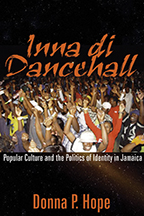
Inna Di Dancehall
Popular Culture and the Politics of Identity in Jamaica
Inna di Dancehall provides an accessible account of a poorly understood and much maligned aspect of Jamaican popular culture. Donna Hope explores the sociopolitical meanings of Jamaica's dancehall culture. In particular, she gives an account of the power relations within the dancehall and between the dancehall and the wider Jamaican society. Hope allows the reader an unmatched insider's view and explanation of power, violence and gender relations in Jamaica as seen through the prism of dancehall.
- List of Illustrations
- Preface
- Acknowledgements
- Introduction
- Setting the Dancehall Stage: The Historical Moment
- Defining the Dancehall
- “Love Punaany Bad”: Sexuality and Gender in the Dancehall
- “Bigging Up Dons and Shottas”: Violence in the Dancehall
- Identity Politics inna the Belly of the Dancehall
- Notes
- Bibliography
- Index
DONNA P. HOPE is Professor of Culture, Gender and Society in the Institute of Caribbean Studies (ICS), Faculty of Humanities & Education, The University of The West Indies, Mona Campus, Jamaica. Her publications include ReggaeStories: Jamaican Musical Legends and Cultural Legacies and Man Vibes: Masculinities in the Jamaican Dancehall.
“The author presents a lively, perceptive, first-hand account of the evolution of Jamaican dancehall culture. Combining scholarship and anecdotal evidence, Hope delineates the complex web of socio-economic and political factors that shape cultural identity in the marginalized working-class communities out which contemporary popular culture arises.”
− Carolyn Cooper, Professor of Literary and Cultural Studies, University of the West Indies, Jamaica