
This title is also available from
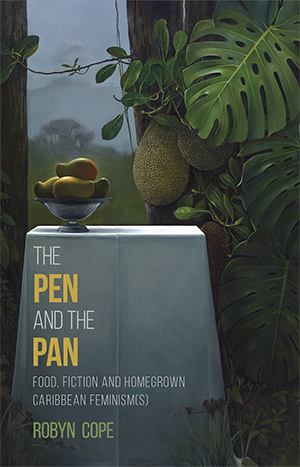
The Pen and the Pan
Food, Fiction and Homegrown Caribbean Feminism(s)
The Pen and the Pan: Food, Fiction and Homegrown Caribbean Feminism(s) is a comparative study of food imagery in contemporary fiction by Guadeloupeans Maryse Condé and Gisèle Pineau, Haitian Edwidge Danticat, and Trinidadians Lakshmi Persaud and Shani Mootoo. Robyn Cope’s key contention is that the past quarter century of Caribbean culinary fiction engenders the Caribbean freedom struggle in two senses of the word: first, by imbuing the history of that struggle with gender sensitivity and specificity; second, by dreaming up a new kind of creative, coalitional Caribbean freedom struggle. Cope reads food imagery in Caribbean women’s writing not only for what it can teach us about the colonizer-colonized binary, but also in order to gain insight into power dynamics within the Caribbean itself – between generations, ethnic and racial groups, religious and political affiliations, social classes and sexual identities, and most especially between women.
Cope’s approach, part of the exciting new field of literary food studies, aims to recover stories that cannot be told without food. By reading these works with and against one another, Cope honours the great geographic, linguistic, ethnic, racial, political and social diversity of twentieth- and twenty-first-century Caribbean women’s experiences with oppression and resistance. At the same time, her reading teases out Caribbean women’s common longing for affirming coalition, symbolized by commensality, that liberates without collapsing difference. In The Pen and the Pan, the shared meal and the shared struggle go hand in hand.
- Acknowledgements / ix
- INTRODUCTION: Food, Fiction and Homegrown Caribbean Feminism(s) / 1
- 1 GISELE PINEAU: Cooking Creole in the City / 26
- 2 EDWIDGE DANTICAT: The Hunger to Tell / 60
- 3 LAKSHMI PERSAUD: Forbidden Fruit / 96
- 4 SHANI MOOTOO: Kitchen Indians / 131
- 5 MARYSE CONDE: The Pen and the Pan / 169
- AFTERWORD: World Travelling / 202
- Notes / 205
- Bibliography / 235
- Index / 249
Robyn Cope is Assistant Professor of French, Department of Romance Languages and Literatures, Binghamton University, Binghamton, New York.