
This title is also available from
Falmouth, Jamaica
Architecture as History
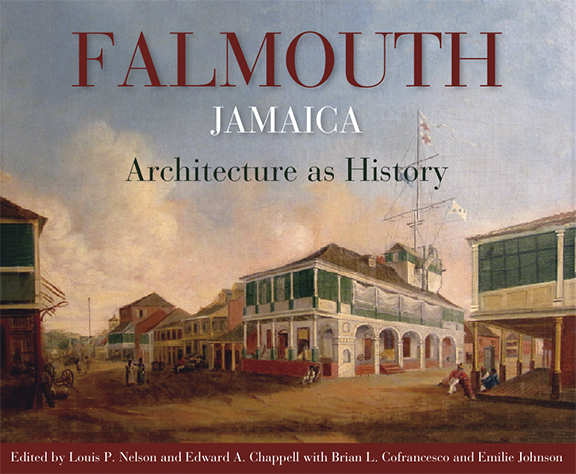
Founded in 1769 as a new port town on Jamaica’s north coast, Falmouth expanded dramatically in the decades around 1800 as it supported the rapidly expanding sugar production of Trelawny and neighbouring parishes. Many of the surviving buildings in Falmouth are the townhouses and shops of the planters and merchants who benefited from the wealth of sugar. That same community also built a major Anglican church and a courthouse, both of which still survive and remain in use. In those same years, Falmouth hosted a growing free black population and this community also left its mark on the historic town. In 1894, Falmouth received an extraordinary gift from the British Crown in the form of the Albert George Market, at once a symbol of persistent colonialism, a shelter for the ancient Sunday markets and a symbol of modernism in the form of its vast cast-iron design. Monuments in the city from the twentieth century include an extraordinary round Catholic church and an impressively Modernist school wing. With little investment through the twentieth century, Falmouth was entirely re-conceptualized in the opening years of the twenty-first century with the construction of a large cruise ship terminal. Spanning from the foundation of the town in 1769 to the opening of the cruise ship terminal in 2008, this book explores the wide range of architecture built by Jamaicans and others in the making of this extraordinary town.
- Introduction
- LOUIS P. NELSON HISTORY OF FALMOUTH
- LOUIS P. NELSON FALMOUTH, JAMAICA: EARLY HOUSING IN A CARIBBEAN TOWN
- EDWARD A. CHAPPELL AND LOUIS P. NELSON TOUR 1 WATER SQUARE AND MARKET STREET
- INTRODUCTION BY EMILIE JOHNSON
- Falmouth Courthouse
- Barrett House, 1 Market Street
- Moulton Barrett House, 7 Market Street
- Baptist Manse, 9 Market Street
- Post Office, 17 Market Street
- Market Street
- Market Street
- Market Street
- Market Street
- Water Square
- Albert George Market TOUR 2 WHARF DISTRICT
- INTRODUCTION BY EMILIE JOHNSON
- RADA Building, 9 Seaboard Street
- Tharp House
- The Dome
- 7 Upper Harbour Street TOUR 3 RODNEY STREET
- INTRODUCTION BY EMILIE JOHNSON
- Fort Balcarres/Falmouth All-Age School
- Victoria Park/ Uriah Rowe Park
- Unity Church
- St Joseph Roman Catholic Church
- Police Barracks
- Trelawny Workhouse and House of Corrections
- Trelawny Gaol TOUR 4 RESIDENTIAL CORE
- INTRODUCTION BY EMILIE JOHNSON
- 1 Trelawny Street
- Elizabeth Somerville House, 8 Trelawny Street
- King Street
- Lower Harbour Street
- Lower Harbour Street
- King Street
- Thomas Davidson House, 1 King Street
- Queen Street
- Princess Street
- Princess Street
- Cornwall Street
- Queen Street
- Cornwall Street
- King Street TOUR 5 DUKE STREET
- INTRODUCTION BY EMILIE JOHNSON
- William Knibb Memorial Baptist Church, King Street
- Duke Street
- Duke Street
- Duke Street
- Neale Tavern, 23 Duke Street
- Duke Street
- Duke Street
- Duke Street
- Newton Street
- Cornwall Street
- Pitt Street
- St Peter’s Anglican Church, Duke Street
- Church View, 54 Duke Street
- POVERTY IN PARADISE
- KATE BRADY AND CATHERINE H. REDFEARN
- Contributors
Louis P. Nelson
LOUIS P. NELSON is Associate Dean for Research and International Programs, School of Architecture, University of Virginia.
Edward A. Chappell
EDWARD A. CHAPPELL is the Shirley and Richard Roberts Director of Architectural and Archaeological Research, Colonial Williamsburg Foundation.
Brian Cofrancesco
BRIAN L. COFRANCESCO is Program Coordinator, Harriet Beecher Stowe Center, Hartford, Connecticut.
Emilie Johnson
EMILIE JOHNSON is Assistant Curator, Monticello, Thomas Jefferson Foundation, Virginia.