This title is also available from
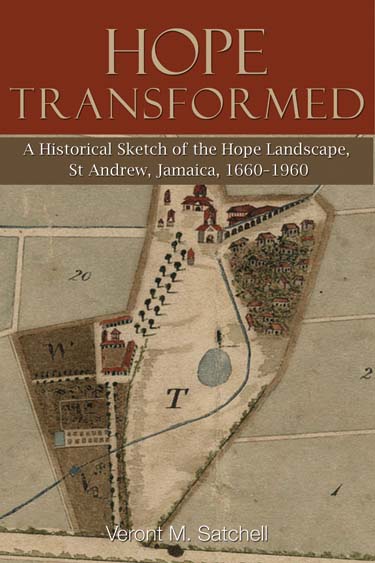
Hope Transformed
A Historical Sketch of the Hope Landscape, St Andrew, Jamaica, 1660-1960
The historic Hope lands located on the Liguanea Plain in the southeastern parish of St Andrew, Jamaica, and once the site of one of the island’s earliest sugar estates, has had a long history of human settlements dating back to approximately 600 CE, the era of the indigenous Tainos. It was not until 1655, however, with the English invasion and seizure of Jamaica from the Spanish, that the Hope landscape developed into a thriving rural agrarian settlement. Generous land grants were made to the invading officers and later to immigrants from Britain and North America and from other Caribbean islands. Major Richard Hope came in possession of over 2,600 acres in the Liguanea Plain. Major Hope, unlike many of his counterparts by the 1660s, managed to establish a small sugar plantation, which developed by the mid-1700s into one of the island’s largest, most productive and technologically advanced slave sugar estates. In the 1770s the estate became the property of the Duke of Chandos and his family until 1848, when the estate was dismantled. Over 600 acres were sold to the Kingston and Liguanea Water Works Company and the remaining 1,700 acres were leased to the owner of the adjoining Papine and Mona estates. Poor accounting and border surveillance enabled several persons to possess the land, which was later sanctioned by the Limitations of Actions Law.
With the government’s acquisition of the entire property in 1909, the Hope estate underwent remarkable changes in the twentieth century. By 1960 the Hope landscape was radically transformed from a sugar estate worked by hundreds of enslaved black people to a premiere urban centre of commercial, residential and educational land use.
- Illustrations
- Tables
- Acknowledgements
- Abbreviations
- Introduction
- 1 Dawn of Hope
- 2 Hope within the Landed Gentry, 1656–1914
- 3 Flourishing Hope, 1660–1821
- 4 Fading Hope, 1822–1848
- 5 Refocusing Hope, 1848–1871
- 6 Hope Rekindled, 1871–1908
- 7 Hope for the People, 1909–1960
- 8 The Hope Palimpsest
- Appendices
- Appendix 1. Proclamation Carried over by Lord Windsor
- Appendix 2. Extracts from Two of Major Richard Hope’s Land Patents
- Appendix 3. Will of Richard Hope, 1670
- Appendix 4. Will of Roger Elletson, 1691
- Appendix 5. Extracts from the Will of Richard Elletson, 1742
- Appendix 6. Extract from the Conveyance of Sale of Part of the Hope Estate to the Kingston and Liguanea Water Works Company, 1850
- Appendix 7. Blue Castle Housing Scheme Submittedby the Housing Association
- Notes
- Introduction
- Chapter 7 Selected Bibliography
- Index
Veront M. Satchell is Senior Lecturer, Department of History and Archaeology, University of the West Indies, Jamaica. He is the author of several books and articles, including From Plot to Plantation: Land Transactions in Jamaica, 1896–1900, Sugar, Slavery and Technological Change, Jamaica 1760–1830, and Emancipation and Reparation. He is currently working on Alexander Bedward: The Lord and Master of August Town, 1891–1921.
Books also of interest