This title is also available from
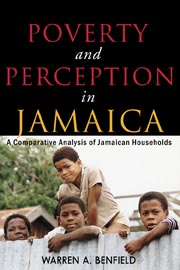
Poverty and Perception in Jamaica
A Comparative Analysis of Jamaican Households
Although many studies exist on poverty in developing countries, traditionally they tend to utilize either a subjective or an objective approach. This study is part of an emerging trend and embraces both methodologies and utilizes qualitative and quantitative data to study poverty in five Jamaican communities. In the course of his research, Benfield found that individuals often defined themselves as poor when the government did not and vice versa. In many cases, individuals did not participate in social and economic programmes because they did not believe they were “poor” although the government objectively defined them as such. For many of these households, their definition of their economic status depended on their access to education, their neighbourhood, their purchasing power for consumable goods, whether or not they received remittances from abroad, and their gender.
Poverty and Perception in Jamaica has major policy implications for Jamaica and the increased economic well-being of its citizens. Benfield proposes problem-solving measures for poverty alleviation and this work makes a significant contribution to the theoretical literature on poverty measurement.
- Illustrations
- Preface
- Acknowledgements
- Abbreviations
- Introduction
- Chapter 1 Poverty and Perception: An Introduction
- Chapter 2 Setting the Poverty Line: An Overview
- Chapter 3 Subjective Poverty Thresholds
- Chapter 4 Modelling Subjective Well-Being
- Chapter 5 Correlates of Household Well-Being
- Chapter 6 Determinants of Objective and Subjective Well-Being
- Chapter 7 Why People Think They Are Poor When They Are Not
- Appendix 1 Description of Variables
- Appendix 2 Minimum Survival Needs as a Function of Consumption
- Appendix 3 Subjective Thresholds Set at the Maximum and Median, 1999
- Appendix 4a Probit Marginal and Impact Effects: The Probability of Being Unanimously Poor (Subjective Self-Classification, 1999)
- Appendix 4b Probit Marginal and Impact Effects: The Probability of Being Unanimously Poor (Objective Estimates, 1999)
- Appendix 5a Probit Marginal and Impact Effects: The Probability of Being Unanimously Poor (Subjective Self-Classification, 1997)
- Appendix 5b Probit Marginal and Impact Effects: The Probability of Being Unanimously Poor (Objective Estimates, 1997)
- Appendix 6a Probit Marginal and Impact Effects: The Probability of Being Unanimously Poor (Subjective Self-Classification, 1993)
- Appendix 6b Probit Marginal and Impact Effects: The Probability of Being Unanimously Poor (Objective Estimates, 1993)
- Appendix 7a Multinomial Logit Marginal and Impact Effects: The Probability of Being Incorrectly Poor, 1999
- Appendix 7b Multinomial Logit Marginal and Impact Effects: The Probability of Being Incorrectly Poor, 1997
- Appendix 7c Multinomial Logit Marginal and Impact Effects: The Probability of Being Incorrectly Poor, 1993
- Notes
- References
- Index
Warren A. Benfield is Research Fellow, Sir Arthur Lewis Institute of Social and Economic Studies, University of the West Indies, Jamaica. He is currently undertaking poverty-related work in Tanzania for the World Bank.
Books also of interest