This title is also available from
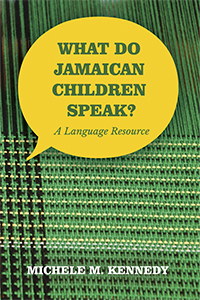
What Do Jamaican Children Speak?
A Language Resource
What Do Jamaican Children Speak? A Language Resource presents a profile of aspects of the lexicon and of the morphosyntax of the speech of Jamaican three-year-olds across the island in their first year of entry into the public school system, the basic school. It is intended to serve as a resource for creolists and acquisitionists, for academics in education, for teachers of literacy and language education, as well as for intermediary and advanced tertiary-level linguistics and education students.
The language to which the children are exposed – their model in acquisition – is characterized by extreme variation and viewed as the “weaving” of features belonging to the two language systems, Jamaican Creole and Jamaican English. This variation is not random or chaotic, however. The patterns of language choice by the children are investigated, showing clearly how it is that features associated with each of the languages are woven in their speech. These findings are used as a basis for recommending an approach grounded in language awareness as the choice pedagogy for the language and literacy classroom in a language environment such as that in Jamaica.
Linguistic analysis, then, is used as a platform, a basis on which to understand the nature of the language that has been acquired by the children and used by them, leading to an informed picture of a possible way forward in English language education, allowing the teacher to transform what are frequently considered hindrances to learning English, into opportunities for learning the language.
- List of Tables
- Acknowledgements
- Abbreviations Used in the Presentation of Data
- Other Abbreviations
- Chapter 1 Laying the Foundation
- 1.1 The Language Situation in Jamaica
- 1.2 Methodology
- 1.3 Limitations of the Study 1.4 Aims of the Research and the Structure of the Book
- Chapter 2 Theoretical Bases of the Study
- 2.1 The Acquisition of a First Language
- 2.2 The Acquisition of a Second Language
- 2.3 The Role of Input in Acquisition
- 2.4 Code-Switching
- 2.5 Minimalism
- Chapter 3 How the Children Use and Create Words
- 3.1 Inventories of Sounds in JC versus JE
- 3.2 The Categorial Composition of the Children’s Vocabulary
- 3.3 Adjectival Modification
- 3.4 Word Formation Strategies
- Chapter 4 What the Children Do with Nouns
- 4.1 Count and Non-Count Nouns
- 4.2 Number Marking in JC versus JE
- 4.3 The Expression of (In)Definiteness
- 4.4 Possessive Noun Phrases
- 4.5 Concluding Remarks
- Chapter 5 What the Children Do with Verbs
- 5.1 Tense
- 5.2 Aspect
- 5.3 Back to Tense
- 5.4 Weaving of JE and JC
- 5.5 Summary and Conclusion
- Chapter 6 Bringing It All Together
- 6.1 Specific Issues in the Nominal and Verbal Domains
- 6.2 The Relative Distribution of JE and JC Structures in the Children’s Usage
- 6.3 Blurred Boundaries and Their “Un-Blurring”
- 6.4 Levels of Language Awareness and Literacy
- 6.5 Concluding Remarks Appendices
- Appendix 1. The Cassidy-JLU Writing System
- Appendix 2. The Lexical–Functional Distinction
- Appendix 3. Other Codes Used for Tagging
- Appendix 4. The Type–Token Distinction
- Appendix 5. SHared Words with Different Meanings
- Appendix 6. JConly Words
- Appendix 7. List of Plural Fossils Used Notes
- References
- Index
MICHELE M. KENNEDY is Senior Lecturer in Linguistics, Department of Language, Linguistics and Philosophy, the University of the West Indies, Mona, Jamaica.
Books also of interest