This title is also available from
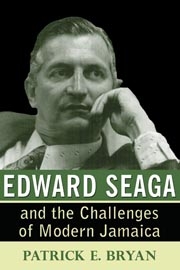
Edward Seaga and the Challenges of Modern Jamaica
This is the first scholarly biography of Edward Philip George Seaga, retired prime minister of Jamaica (1980–1989) and former leader of the Jamaica Labour Party (1974–2005). Patrick Bryan examines Seaga in light of the twentieth-century history of Jamaica, which experienced the challenges of race, colour, economic dependence, the transition from the British colonial period to independence in 1962, and the challenges of creating a Jamaican national state and separate cultural identity. Although the study focuses on Edward Seaga, the historical forces that shaped Jamaica’s history are central, in particular the way in which he confronted these forces. In placing Seaga in historical perspective, this work strikes a seasoned and balanced analysis of the man and is neither an apologia nor iconoclastic. Based on a variety of primary sources, government records, interviews and secondary sources, the author paints a compelling portrait of a complex man, a contradictory mixture of idealism and pragmatism, but, above all, a Jamaican nationalist who had a profound impact on Jamaican politics, tourism, culture and finance.
- Acknowledgements
- Abbreviations
- Introduction
- 1 Precedents: Jamaica, 1891–1930
- 2 Towards a New Jamaican Political System
- 3 The Years 1944 to 1959
- 4 Entry into Politics, 1959–1962
- 5 Edward Seaga and the British West Indian Federation
- 6 Preparing for Independence
- 7 The Jamaica Labour Party Administration of 1962–1972
- 8 Edward Seaga: Minister of Development and Welfare
- 9 Nationalism: Culture and Integration
- 10 Community Development: The Case of Tivoli Gardens
- 11 The Seaga Succession
- 12 Edward Seaga and the Michael Manley Regime, 1972–1980
- 13 Prime Minister Seaga: Euphoria
- 14 Years of Optimism, 1980–1983
- 15 Structural Adjustment
- 16 Seaga and the Grenada Invasion
- 17 Years of Crisis, 1983–1986
- 18 Recovery and Defeat, 1987–1989
- 19 Seaga in Opposition, 1989–2005
- 20 Farewell to Politics
- Notes
- Selected Bibliography
- Index
Patrick E. Bryan is Douglas Hall Professor of History, University of the West Indies, Jamaica. His publications include The Haitian Revolution and Its Effects; Philanthropy and Social Welfare in Jamaica; The Jamaican People, 1880–1902; Jamaica: The Aviation Story; The Legacy of a Goldsmith: A History of Wolmer’s Schools; Inside Out and Outside In: Factors in the Creation of Contemporary Jamaica. He is also the co-editor (with Rupert Lewis) of Marcus Garvey: His Work and Impact and (with Karl Watson) of Not for Wages: Eyewitness Summaries of the 1938 Labour Rebellion in Jamaica.
“For teachers, police, nurses, doctors, lawyers, accountants, surveyors, professionals, the reading and study of this book is mandatory. For the judiciary, and all parliamentarians and the diplomatic corps, the reading and study of this book is compulsory. For all non-Jamaicans, working short- or long-term in Jamaica, the reading and study of this book is essential.”
– Gerald McLaughlin, Sunday Observer, 21 March 2010